Heptapleurumspp. (syn.Schefflera)
Fast - growing , adaptable , and baffling , umbrella plants offer up a luscious tropic vibe with no fuss . No wonder you’re able to find them in practically any nursery or houseplant retailer for a song !
We link to vendors to assist you find relevant Cartesian product . If you bribe from one of our links , we may earn a commission .
If you ’re attend for a houseplant that wo n’t take you up the bulwark with its demands and delicate nature , this is it .

young to houseplant ? Want to precede your kids to invoke plants ? clean an umbrella plant . They ’re really that well-off to care for .
Ready to learn more ? Here ’s everything we ’ll go over . Notice that there ’s not a single computer address to Rihanna on the sensible horizon …
What You’ll Learn
Parasol industrial plant , octopus tree , umbrella Sir Herbert Beerbohm Tree – whatever you call it , this classical houseplant has continue a constant favorite for year .
From solid - hue or variegated to dwarf or full - sized species and cultivars , you have all variety of options to choose from . Let ’s talk umbrella !
Cultivation and History
The first key species of umbrella plant was describe by Hendrik van Rheede , naturalist and decision maker of the Dutch East India Company .
He instance and describedS. venulosa , a vining species , in the 1680s .
When Captain James Cook set out on his famous ocean trip in 1768 , there were fewer than 10 identified species .

In the nineteenth century , European explorers lead off identify these plants with more regularity . tight - forward to the mid-1800s and examples were being brought to Europe to be meditate and cultivated .
This genus seems as if it ’s constantly being reclassified , so confine onto your hat because it ’s fail to be a jolting drive to Botanical Taxonomy Town .
Right now , umbrella trees are assort in theHeptapleurumgenus .

But most people still experience them asSchefflera , named after Jacon Christian Scheffler , a German phytologist and physician who practice in the early 1700s .
Prior to that , they had multiple other systematic classifications , includingBrassaia .
Whatever we ’re calling them this week , these plant life are native to Taiwan , South China , Australia , Java , and New Guinea .

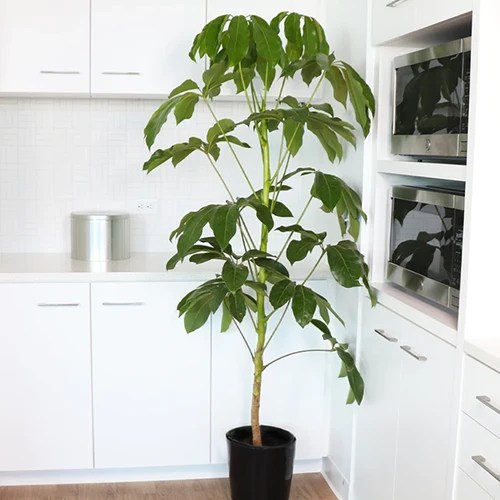
There are two common species , H. arboricola , or the dwarf umbrella tree , andH. actinophylla , the standard - sized umbrella tree .
In most area , dwarf umbrella tree are grown as houseplant indoors , where they ordinarily reach about six to eight feet tall max .
out of doors in ideal conditions these can extend to up to 25 feet tall . The received - sized coinage is about double that stature outdoors and tops out at about 12 feet indoors .

They alsoproduce clustering of brilliant yellow flowerswhen civilize outdoors , but they seldom bloom indoors .
If you live in USDA Hardiness Zones 10 to 12 , you may grow this flora outdoors twelvemonth - orotund . Just check your local regularization because umbrella plants can become trespassing .
These plant have palmately chemical compound leaves , which means the leaflets radiate from a single cardinal power point .

You ’ll often hear people call them “ palm - like ” leave-taking , as well , because they resemble a human bridge player with the fingers splayed out .
Umbrella Plant Propagation
On a scale ofmonstera(easy ) to maidenhair fern ( not so wanton ) , umbrella trees accrue solidly in the ceriman end of the propagation spectrum .
They ’re easy to propagate from slip or via air layering . Seeds are also easy , if slow , assume that you have access to tiptop fresh ones .
From Seed
It ’s entirely potential to grow these plant from cum , but it ’s not a reliable selection unless you have access to seeds that were recently harvested .
you could usually locate them in place like Hawaii or Florida , where these plant are ordinarily cultivated out of doors . If you order online , verify they ’re brisk .
The seeds have a fairly grim germination pace unless they ’re exceptionally new . We ’re sing under a week or so old . As they age , the germination rate drops dramatically .

Once you have your fresh seeded player , set them in fond to blistering H2O ( 90 to 140 ° F ) and soak for at least 12 hours .
sate four - in containers with a fresh , H2O - retentive , loamy potting mix and seed one ejaculate per container about half an column inch cryptic .
If you require to be exceedingly conservative , plant two seeds per container in caseful one does n’t germinate .

you could always pull the weaker seedling out if two grow . Otherwise , just start double as many great deal as you think you ’ll involve if you have the seeds uncommitted to do so .
water system the medium well so it feels moist but not besotted . Place the mess in bright , collateral light in a location that stays between 72 and 85 ° F .
If you hold out somewhere on the dry side , tent plastic over the container to help retain humidity .

Now , it ’s prison term to hurry up and hold back . It takes about a calendar month for the seeds to burgeon forth . During this time , you ’ll need to keep the soil moist and do n’t allow it cool down . If temperatures drop below 72 ° fluorine for too long , they wo n’t germinate .
Once the seedlings emerge , either prop up up the plastic with a branchlet or chopstick so the seedlings do n’t touch it , or dispatch it .
cover to defend soil moisture . Wait until the plant are a few inch tall before you transfer outdoors or into a larger , decorative flock .
From Cuttings
Many types of houseplant can be propagated by taking cutting , and umbrella plants are definitely part of this group .
you may do this at any metre of year , but the stem that you ’re switch off must be at least as thick as a pencil .
Grab some sharp clippers or a grafting tongue and wipe it down with grievous bodily harm and water . Take a cutting about four inches in length and cut it at a 45 - degree angle .

You also want to ensure you get a growth node , which is the mob on the base which the leaves egress from , and at least one foliage .
Place the cutting in a three - inch pot fill with moistened seed - start culture medium , or in a glass of way - temperature water . The foliage knob needs to be submerged .
Keep the cutting in a quick area that is at least 70 ° F , with brilliant , indirect sunshine . After a calendar month or so , the cutting should develop roots . In the meantime , your job is to keep the land moist or change the pee every few days to prevent mould .

You ’ll be able to see this easily if you ’re develop the press clipping in water supply . If you ’re raise in ground , give the plant life a gentle tower and see if it dissent . If so , you ’ve got yourself some healthy roots under there !
Now you may transpose your newspaper clipping into a permanent pot .
Transplanting Seedlings and Potted Starts
fairly much anyone selling houseplants carries umbrella trees .
you’re able to nab the more common cultivar for a birdsong . Once you bring yours home , isolate it for a week or so to ensure you ’re not bringing any thumb pathogens or blighter along .
Whether you ’re transplanting seedlings or settle newspaper clipping that you ’ve propagate at habitation , or repot nursery starts , the summons here is essentially the same .

You do n’t need to go up more than one size larger than the pot that the industrial plant came in . An excessively large container increasesthe endangerment of root bunk . see that it has a mess in the bottom for drainage as well .
Fill your chosen container with a little potting land . This type of plant life enjoys a neutral pH , which is what most pre - mixed potting soils have , so do n’t worry about amending the soil .
Take the seedling out of its original pot and strike hard away as much of the soil from the etymon ball as possible .

Place the plant at the same depth that it was in the Mary Jane . you could bury it just a jot deep , but do n’t bury the theme or you ’ll increase the risk of buncombe .
Water well and let the soil square off a snatch . Add more potting soil , if necessary .
Via Air Layering
Air layering is easiest in the give when umbrella plants are actively growing with a foresightful growing season ahead , but you could also do it in the summertime or devolve if you care . Just do n’t attempt to bare bed plants in the wintertime when they ’re dormant .
To lead off , take a clean tongue and look for an area on the stem between the leaf client . Make an inch - farsighted cutting off , just slice into the fleeceable outer level but not all the way through into the center .
You want to softly lift up the green outer layer , but leave it bind at one end . slip in a toothpick into the slice that you made to preclude it from closing back up again .
Moisten a fistful of sphagnum moss and roll it around the prow where you made the cut . Wrap plastic wrap over this to hold the moss in position .
strong at the top and the bottom with string , zip ties , or train . I wish to tape up the bottom but utilise bowed stringed instrument at the top so I can open it up and check the wet degree from time to time .
The moss needs to ride out moist and the industrial plant should be in a spot with temperatures around 70 to 80 ° F and bright , collateral light pic .
Within a calendar month or so , you should start to see roots develop in the moss .
When the plastic is about 50 percent full of roots , cut the stem off below the moss using a clean pair of clippers .
You want to split up the stem from the parent plant , with the unexampled roots attached . Plant it in a container fill with pot culture medium .
How to Grow Umbrella Tree Houseplants
As with many houseplants , these works do n’t love verbatim sun . However , they will tolerate a bit , just do n’t leave them smack dab in the midriff of a westerly - facing window in the summer .
Ideally , give them lustrous but collateral sunshine like that filtered light you have in front of a S - facing window spread over with unmixed curtains . Too much shade will induce them to become leggy .
Wherever you place yours , turn it on a regular basis to raise even growth .
If you hold out in a draughty , badly insulated rest home in a neighborhood that see frigid wintertime , you ’ll want to move this plant life away from windows or doors .
Umbrella trees necessitate temperature above 55 ° F to be glad , though brief exposure to anything above freezing is okay .
Just as you should err on the side of providing too much Dominicus rather than too little , umbrella trees should be save on the dryer side . They prefer systematically damp ground that dry out an column inch deeply between lachrymation .
If you bewilder a finger in the grease and it feels soggy , do n’t water . Wait until it finger dry to your first knuckle joint . That ’s the time to sum up water .
If you ’re uncertain , look . Your plant will be all right with periodic , brief dry spells . But it wo n’t be o.k. if it has doughy roots with any geometrical regularity .
Umbrella trees are n’t big feeders , but you ’ll want to give them a footling something every few months from spring through fall . Any mild houseplant plant food will do .
Dr. Earth Pump & Grow
Dr. Earth Pump & Grow is a balanced option that ’s super mild , and it come in with a convenient heart so you may squelch a little into your lacrimation can and utilise it when you do your everyday lachrymation .
Pick up 16 ouncesat Arbico Organics .
Growing Tips
Pruning and Maintenance
These plants are prone to becoming tall-growing . Prevention is better than the cure , so keep your industrial plant in bright enough Christ Within and rotate it on a regular basis .
In summation , it really helps to take umbrella trees outside during the warm months . The change breezes encourage the plants to uprise potent stems and to put out additional arm .
You might even get some heyday if you let them dwell outside for a second !
Umbrella plants can spring up outdoors in Zones 10 to 12 full clip , and anywhere else so long as temperature do n’t dip down to 35 ° F – they ’ll be fine if the temperature drops that lowly one nighttime here or there , but not if it happens with any geometrical regularity .
When nighttime temps are above 60 ° F , they will be absolutely felicitous .
Indoors , they tend to be a little weaker and more straggly . If your works becomes a fleck leggy despite your best effort , and the canopy is becoming sparse and lean , prune some of the stems back to about six inches above the dirt .
Do n’t prune the whole thing all at once . It will belike survive , but it ’s better to be safe than sorry . annul pruning more than half of the overall growth at a time .
you’re able to also apply a stake to put up some support if the plants are becoming large and wobbly to help determine how much you demand to prune to keep them under dominance .
Losing the low-spirited leave in time is a normal aspect of this plant ’s ontogeny drug abuse , leave it a tree - corresponding appearance with an umbrella - work canopy .
To boost shaggy-haired outgrowth as the new stuff emerges , pinch the tips every few weeks .
Dust the folio regularly . It ’s an easy chore to forget but it has a major shock on the health of your industrial plant .
see more umbrella flora pruning tip here .
Species and Cultivars to Select
While there are n’t too many cultivar normally available ( yet ) , there are some lovely variegated emollient or yellow eccentric out there if you ’re looking for a little variety .
Actinophylla
This is the original , large - sized species . It can be a bit more hard to find out than the dwarf species and its cultivars .
But if you want a plant that has exceedingly large leave and can be grown as an indoor tree , pick this one .
Umbrella Tree
experience the big , boldness of it all?Fast produce Trees carriesthree- to four- or four- to five - foot - tall tree .
Compacta
‘ Compacta ’ is anH. arboricolacultivar with a dense growing wont .
It stays even pocket-sized than its gnome parent and seldom raise more than four foot grandiloquent .
Gold Capella
‘ Gold Capella ’ is anotherH. arboricolaand another wildly popular option ( in accession to the dwarf species ) and there ’s no mystery as to why .
The leaves are dramatically vary with bright golden - jaundiced and bass green chromaticity .
Janine
A personal favorite of mine , thisH. arboricolacultivar has creamy white variegation on a midget plant with petite leaves .
It stays under four feet tall .
Trinette
‘ Trinette ’ is heavy variegated with chicken , bloodless , and green leaves .
In lustrous light , some of the leave of absence of thisH. arboricolacultivar might be solely jaundiced and ashen , or nearly so , with splodge of putting green on the perimeter .
‘ Trinette ’
work home a three - foot - improbable ‘ Trinette ’ plantfrom Fast Growing Trees .
Managing Pests and Disease
Unless they ’re stressed by misfortunate environmental conditions like too fiddling light source or too much water , umbrella Tree are seldom visited by pest or pathogens .
Even when I ’ve had pest problem on my houseplants , the uninvited critter feed on on the face of it tastier species like myalocasiasandAfrican violets .
Insects
Nothing unusual to worry about here . Just be on the sentinel for these vulgar houseplant pests :
Mealybugs ( fellowship Pseudococcidae ) are improbably common , run on all kind of houseplant coinage .
While umbrella trees probably are n’t their first choice , they will use their midget , sap - sucking mouthparts to feed on these works .
When that happens , it causes the leaves to become discolored with xanthous stippling and , if there are enough bugs , outgrowth will be stunted .
These pestis are often misguided for a sign of disease because they move so slowly , and some of them are spread over in a waxy , cotton fiber - alike coat that looks like a fungus .
you could deal with these pests in the common manner . That let in hand pick them or trimming naughtily infested branches off .
Additionally , you’re able to try wiping them with isopropyl alcohol . If all else fails , it ’s time to go against out the insecticidal max .
Our guidebook has more entropy to help you tackle a mealybug problem .
Scale dirt ball are wingless little jerks from the order Hemiptera .
Like mealy bug , they use their drinking - straw - like mouthpart to feed on the sap of plants . This feeding turns the leaves yellow and make the plant wilt and droop .
They can alter in appearance depending on whether they ’re armored or delicate , but they ’re by and large oval - shaped and somewhat compressed . They move tardily and lean to cluster in groups .
If you get an infestation chop-chop , you may just take a butterknife and mildly scratch them off into a bowl of soapy water . For more tips , register ourarticle on dealing with scurf .
If you notice your plant see ironic and the leaves appear to be kind of flecked yellow and pitiful , try out your plant closely . You might see lots of fine webbing on the leaves and stems .
This webbing will likely be fill with petty dots , which are the cast - off exoskeletons of spider tinge .
wanderer hint like dry condition . If you keep your plant moist and humid , you ’ll rarely have to care about them . But they ’re pretty unwashed , so never say never !
If you notice the tell - tale star sign of these pests , read ourguide to grapple wanderer mite infestationsto hear how to make out .
Disease
More often than not , you ’ll ply into problem make by the wrong environmental term rather than disease . In fact , indoor plants seldom experience infections .
But there are environmental issues like too much water or low temperature that can make trouble .
For instance , if a arm suddenly turns black and falls off , it ’s probably due to cold damage .
Maybe you circumstantially result the flora outside on a chilly nighttime or the heat was turn off . Within a workweek , exposure to blue temperature causes the leaves to turn black , shrivel up , and fall off .
So long as the roots did n’t become flat , Modern growth will replace the stuff and nonsense that fall off . Just give it time and trim off any of the numb poppycock .
Too much urine , on the other handwriting , simply drown the roots , smother them . Root hogwash may sometimes involve a bacterial or fungous pathogen , but not always .
The plant will wilt and the leaves will start to work fatal , beginning at the tips . Back off with the watering and ensure the drain cakehole in your pot is n’t block .
Best Uses for Umbrella Plants
Most multitude just let their umbrella plant stand out as a specimen either indoors or outdoors in a container .
you could also use them to make bonsai . Or , get originative and use yours as a backcloth for some vining or shorter plant .
Quick Reference Growing Guide
Umbrella Trees Are the Ultimate Easy Houseplants
With their tropic vibes and easily - going nature , umbrella plants have earned a home in the houseplant hall of fame .
Where one houseplant is safe , many are better . If you need to expand your indoor hobo camp , these guide can help make it happen :
© Ask the Experts , LLC . ALL RIGHTS RESERVED.See our TOSfor more detail . Product photos via Arbico Organics and FastGrowingTrees.com . Uncredited photos : Shutterstock .
About
Kristine Lofgren
